THE STUDY OF THE FACULTY OF INTERNATIONAL BUSINESS AND ECONOMICS (REI) ON BOOSTING ROMANIA’S BILATERAL ECONOMIC RELATIONS WITH STRATEGIC PARTNERS IN ASIA
Ambassador (p) Gheorghe Savuica *
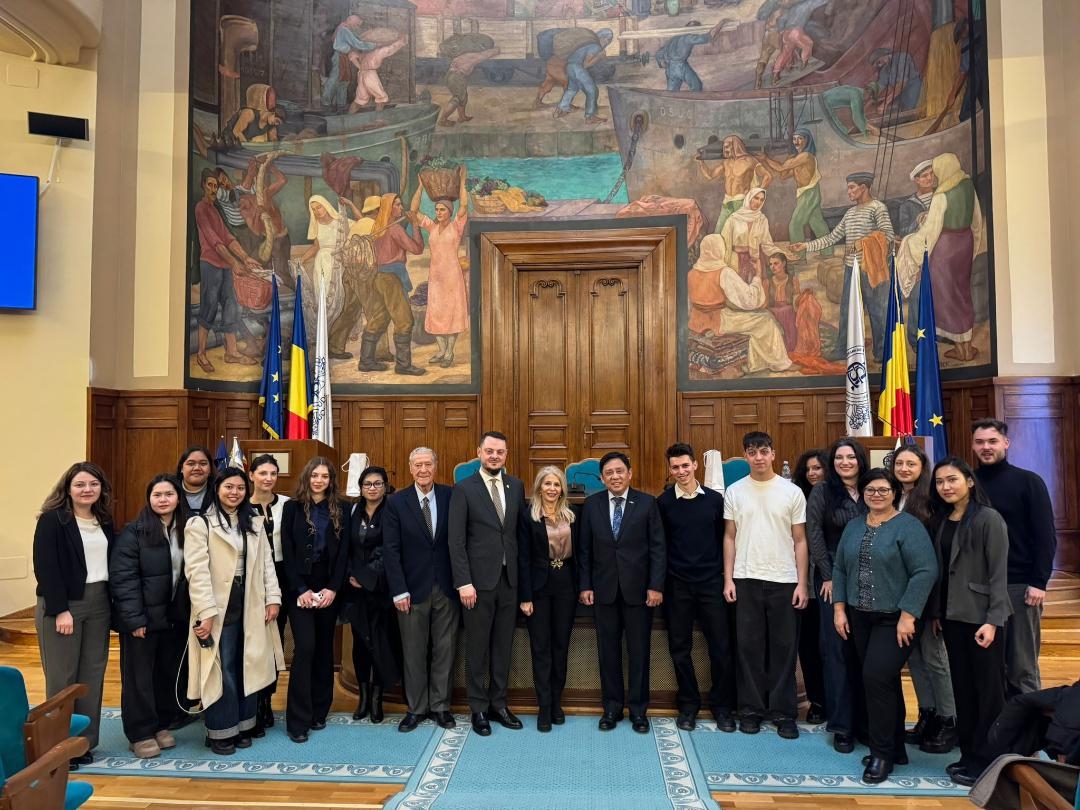
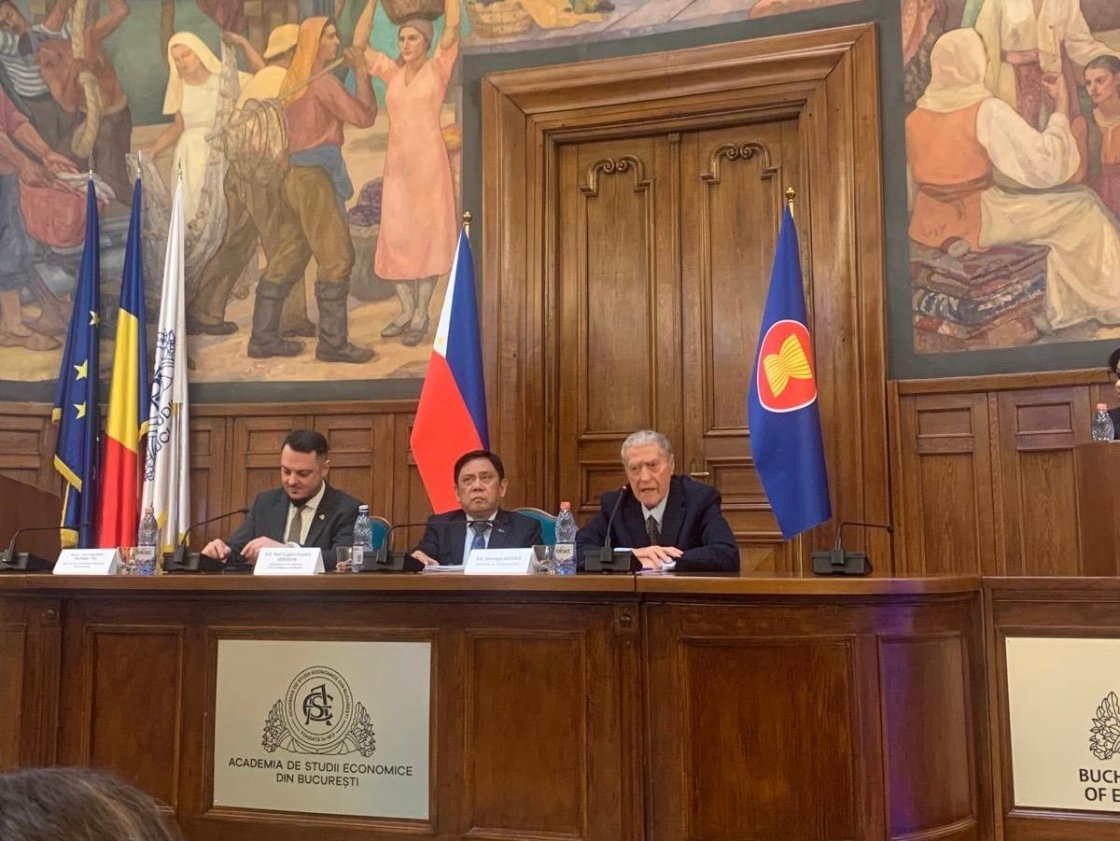
By an attendance of over 100 persons, the students of the Bucharest University for Economic Studies (ASE) and members of the diplomatic corps, academic society, government officials, including a Senator, followed with great interest the Talk given by the Ambassador of the Republic of the Philippines to Romania, Noel Servigon, on “the Philippines Chairship of the Association of the Southeast Asian Nations (ASEAN)”, which carried the theme “Navigating Our Future Together” and the Study on “Boosting Romania’s Bilateral Economic Relations with Strategic Partners in Asia”, by Professor Alexandra-Lavinia Horobet, PhD, and Associate Professor Oana-Cristina Popovici, PhD, Faculty of International Business and Economics (REI).
The event took place in the ASE AULA MAGNA, on 24 February 2026, and was organized by the Philippines Embassy in Bucharest and co-organized by ASE’s Faculty of International Business and Economics (REI), with the support of Professor Anca Ilie, PhD, Vice- Dean and the Romanian Institute for Europe-Asia Studies (IRSEA), whose Founder and President is Ambassador (p) Gheorghe Savuica.
The significant moment also coincided with the 50th anniversary of the signing of the Treaty of Amity and Cooperation in Southeast Asia (TAC), which Romania intends to accede to in 2026. One day after, the Romanian Parliament adopted the Law on adherence to TAC. This very responsible political move, after being materialized, will open the ways to Romania to diversify and intensify the cooperation with ASEAN, in concurrence with the opportunities provided by the EU-ASEAN strategic partnership.
The talk was opened by Associate Professor, PhD, Ioan-Radu Petrariu, Dean of the Faculty of International Business and Economics.
In his remarkable speech, Professor and Dean Radu Petrariu presented ASEAN as one of the most successful regional organizations in the world, becoming an important actor in global trade, diplomacy, and multilateral cooperation.
The relations between Romania and ASEAN have a long-standing history of political and economic engagement, which has evolved from bilateral relations with individual ASEAN member states toward a more structured partnership, including through the European Union and, more recently, through ASEAN-centered mechanisms.
From Romania’s perspective, relations with ASEAN are guided by several key priorities: economic cooperation, education, and culture.
Economically, Romania aims to strengthen and diversify its partnerships with ASEAN countries. In an increasingly complex geopolitical environment, marked by global uncertainty and shifting supply chains, diversification of trade and investment relations has become not only an opportunity, but a strategic necessity.
At the European level, the European Union and ASEAN entered into a strategic partnership in 2020. The EU has already concluded free trade agreements with Singapore, Vietnam and Indonesia. These developments place ASEAN at the center of Europe’s external economic relations.
Romania actively supports the implementation of the EU Strategy for Cooperation in the Indo-Pacific and the EU–ASEAN Plan of Action for 2023–2027, advocating for stronger connectivity between our two regions. This connectivity is not limited to trade and infrastructure; it also includes digital cooperation, green transition, education, and cultural exchanges.
Education and culture constitute an essential pillar of Romania’s engagement with ASEAN.
Encouraging students from ASEAN countries to study in Romania, and particularly at the Bucharest University of Economic Studies, is not only an academic goal, but also a long-term investment in bilateral relations.
Cultural diplomacy helps transform formal partnerships into living relationships between peoples and communities. It fosters respect, curiosity, and long-term friendship. We express our openness and willingness to host in our university, in the "Mihai Eminescu" building where our faculty is head quartered and beyond, events presenting ASEAN member countries, stimulating the curiosity of our students to meet and discover your national cultures and values.
In the current geopolitical context, Romania, like many other EU member states, seeks to expand and diversify its commercial partnerships. ASEAN represents a solid pivot in Romania’s foreign economic policy.
Despite the historical presence of Romania in several ASEAN countries, our visibility in terms of trade volume and diversity of economic relations remains modest. This gap between potential and reality is precisely where academic research and strategic reflection become essential.
This brings me to the contribution of our Faculty of International Business and Economics.
One of our flagship research initiatives is the study entitled “Boosting Romania’s bilateral economic relations with its strategic partners in Asia.” The study is carried out in the broader geopolitical, strategic, and geo-economic context that defines today’s international environment.
The research focuses, among others, on ASEAN countries. It explores both opportunities and structural challenges in developing deeper bilateral economic ties.
Without anticipating the detailed presentation that will be delivered shortly by my distinguished colleagues, Professor Alexandra Horobeț and Associate Professor Oana Popovici, I would like to highlight just a few general ideas emerging from this study.
First, ASEAN economies are characterized by strong growth dynamics, demographic vitality, and increasing integration into global value chains. These features make them highly relevant partners for Romania and for the European Union as a whole.
Second, Romania possesses historical contributions in several ASEAN countries, particularly in fields such as energy, construction, engineering, and education. These assets, although less visible today, can serve as foundations for renewed cooperation.
Third, the study emphasizes the need for a more targeted, niche-oriented approach: identifying specific sectors where Romania can offer competitive advantages, such as agri-food products, green technologies, IT services, education, and professional training.
Finally, the research underlines the importance of institutional cooperation between universities, research centers, chambers of commerce, and the private sector, in order to translate strategic vision into concrete projects.
In his outstanding presentation, Ambassador Servigon, who was formerly the Permanent Representative of the Philippines to ASEAN in Jakarta, Indonesia, gave a background of the ASEAN’s establishment and membership, as well as the Treaty of Amity and Cooperation in Southeast Asia and the ASEAN Charter.
He highlighted the three main priorities of the Philippine Chairship of ASEAN- Peace and Security anchors, Prosperity corridors, and People empowerment, focusing on the deliverables of the Prosperity corridors.
Under the Prosperity corridors, the Philippines has identified five strategic trusts, each of these thrusts including a number of concrete deliverables.
The first strategic thrust is “Strengthening Trade and Investment Linkages”. The Philippines look to strengthen economic security and resiliency to ensure a competitive and attractive ASEAN supported by the world-class skills and talents of ASEAN peoples, with seven deliverables:
1. ASEAN Leaders’ Declaration on Strategic Trade Management for Secure Regional Trade;
2. Advancing ASEAN Energy Interconnectivity through the Operationalization of the Enhanced Memorandum of Understanding (MOU) on ASEAN Power Grid (APG);
3. Leader's Declaration on the Cross-Border Movement of Digital Workers;
4. Sustainable and Resilient ASEAN Capital Markets;
5. ASEAN Semiconductor Roadmap: Enabling Pathways for Strategic Investment;
6. ASEAN Critical Minerals Strategy for Regional Resilience and Sustainable Growth;
7. Conclusion of ASEAN-Canada Free Trade Agreement Negotiations.
The second strategic thrust is “Accelerating Digital Transformation”. The fast emergence of technological advancement requires empowering businesses in the digital world. As such, for 2026, the Philippines are looking to utilize emerging technologies – specifically AI- Artificial Intelligence, and facilitate digital connectivity in ASEAN.
The proposed deliverables are:
1. Signing of the ASEAN Digital Economy Framework Agreement (DEFA);
2. ASEAN Leaders’ Declaration on AI-Powered MSME Growth;
3. Advancing ASEAN Regional Payments Connectivity.
The third strategic thrust is “Integrating ASEAN’s MSME Development Agenda” through the establishment of the ASEAN Center of Excellence for MSMEs. For 2026, the Philippines target the adoption of an ASEAN Leaders’ Declaration on the establishment of this center, together with the Terms of Reference for the center. Manila stands ready to host this center in the Philippines which are meant to formally be established over a three-year period.
The fourth strategic thrust is “Leveraging Creative Economy and Innovation” to expand economic opportunities and promote economic integration in our region.
The proposed deliverables are:
1. Establishment of the ASEAN Center of Excellence for Creative Industries (ACE – CI);
2. Intellectual Property Valuation Handy Manual for ASEAN;
3. ASEAN Declaration on the Advancement of Space Science Technology Innovation Cooperation (ASEAN Declaration on Space Cooperation);
4. Regional Program for Science, Technology, and Innovation on Artificial Intelligence and Phase 1 for Health.
For the last strategic thrust, the Philippines will build on the foundations of Malaysia’s 2025 chairship by “Advancing Sustainable and Inclusive Economies”.
Will promoted initiatives that encourage green investment, sustainable finance, and climate-smart industries to ensure that future generations inherit not just a rich and innovative region, but also a healthier planet.
The proposed deliverables are:
1. ASEAN Implementation Plan for Regenerative and Resilient Agriculture Systems;
2. Driving Financial Health Forward: Unlocking the Next Frontier of Financial Inclusion;
3. Greener Future-Implementation of the Regional Investment Promo on Ac on Plan 2025-2030;
4. ASEAN Sustainable and Resilient Tourism Investment Strategy.
Ambassador Noel Servigon concluded that the Philippines Chairship will strive to become a catalyst for regional transformation, while the three priorities and the Five Strategic Thrusts chart a balanced path toward innovation and sustainability.
In his opinion, close collaboration and cooperation with partners like the EU will drive mutual resilience and growth.
The Study “Boosting Romania’s Bilateral Economic Relations with Strategic Partners in Asia” is pointing out that in an era of accelerating shifts, the Indo-Pacific region has become the geo-economics and geostrategic nucleus of the 21st century, having ASEAN as the geopolitical and economic epicentre, serving as the essential "passage between oceans". EU and ASEAN have elevated their relationship to a Strategic Partnership, focusing on digital standards, sustainability, and regional stability.
Such an evidence is requiring Romania to develop a coherent approach to the region’s opportunities and security challenges by changing its position from "strategic inhibition" to "smart alignment“, seeking to maintain its Euro-Atlantic values while pragmatically opening toward Asian markets. There is a need for a National Indo-Pacific Strategy.
The Study includes several recommendations:
- Modernize the Port of Constanța as a Geostrategic Pivot - Romania as the "Western terminal" for trade corridors originating in Southeast Asia;
- Create "Asia-Ready" Industrial Parks to attract relocated production from Asia;
- Prioritize Productive High-Tech FDI;
- Transition to "Strategic Labor Corridors”;
- Strengthen Targeted Economic Diplomacy;
- Integrate Asian Factors into Macroeconomic Monitoring.
The above presentation is based on the integral quotations from the official document and the speeches delivered on this occasion.
In my position as Founder and President of IRSEA as well as co-organizer of the event, I would like to express my profound confidence in a successful Philippines Chairship of ASEAN in 2026, added by my sincerest wishes of great success!
The speeches, study and debates proved that the Talk was a very significant moment to know how ASEAN will be acting and what could be its achievements in 2026. As a normal complementary figure, the audience was acknowledged with important aspects of the relations between Romania and ASEAN member countries and ASEAN as a successful Association in Southeast Asia and beyond.
The most important conclusion as far as the relations between Romania and ASEAN member countries are concerned comes from the essence of the expressed data, positions and remarks leading to the necessity to boost, to the mutual benefit, the current process of developing Romania-ASEAN and ASEAN-Romania relations within the uncontested truth and reality that Southeast Asia, Asia-Pacific as whole and Romania have a very important strategic role in the global development, peace and stability.
Romania was among the first countries in Europe to recognise ASEAN as per its Charter, i.e. as a regional association for economic and not military cooperation. It shows the historic importance accorded by Romania to ASEAN and the whole Asia-Pacific region.
Since its foundation, which coincided with my joining the diplomatic activity, in August 1967, I contributed to drafting Romania’s position on ASEAN, and then I consistently followed and supported the course of the Association in my different official duties in the Ministry of Foreign Affairs of Romania as well as the Head of Diplomatic Missions of Romania, among others, to Indonesia, Malaysia and the Philippines – three out of today eleven members of ASEAN. I continue to do it with full dedication.
IRSEA is actively promoting the strengthening of the partnership between Romania and ASEAN member countries, ASEAN and Asia-Pacific region.
Concluding, I would like to express my profound thanks to all participants, speakers and organizers of this successful event.
* The author is the Founder and President of IRSEA and Founder and Honorary President of Romania-Malaysia Chamber of Commerce and Industry. He is a graduate of Moscow State Institute of International Relations. As a career diplomat with over four decades of diplomatic service, an University recognized specialist on Southeast Asia and ASEAN, speaker of Bahasa Indonesia, Russian and English, he represented Romania as Ambassador Extraordinary and Plenipotentiary to Pakistan and Indonesia and Chief of Mission, with Cabinet Letter, to Sri Lanka, Malaysia, the Philippines, Cyprus, Finland and Estonia.
He published multiple articles, thought-pieces and commentaries reflecting his views on current dynamics in International Affairs and the ongoing developments related to the greater scope of Europe Asia relations. He authored several major chapters in edited volumes on Romania’s Foreign Policy, published by the Romanian Academy.
Ambassador (p) Savuica is a former Director of the Republic of Moldova Division, former Director of the Asia Pacific Division and former Director General of the Asia Pacific, Middle East, Africa and Latin America Department in the Ministry of Foreign Affairs of ROMANIA.
He is married and has two daughters, a granddaughter and a grandson.
.